

Jill Knouse on embodiment, retreat, and practicing yoga inside real life
At the Bend Yoga Festival, we love to feature teachers whose work is grounded, honest, and shaped by lived experience — not trends or performative ideals. Portland, Oregon-based Jill Knouse brings exactly that kind of depth. With nearly two decades of teaching experience, Jill’s approach weaves strong physical practice with self-inquiry, play, and relational awareness.
Ahead of her offerings at the 2026 Bend Yoga Festival, I sat down with Jill to talk about embodiment, effort, — and how yoga can meet us inside full, complex lives.
Angela (BYF): Jill, you’ve been teaching yoga for almost two decades, and your work blends physicality, self-reflection, and community. Before yoga became your life’s work, you spent many years in the financial industry. How did that chapter shape the way you approach yoga and embodiment now?
Jill Knouse: Before yoga became my life’s work, I spent 15 years in the financial industry, a world that rewarded speed, productivity, and performance. On the surface, it couldn’t look more different from yoga. And yet, that chapter deeply shaped me.
I learned what it feels like to live primarily from the neck up. To override intuition. To measure worth through output. I also learned how common it is for capable, intelligent people to feel disconnected from their bodies while appearing “successful.”
Angela: That sense of living “from the neck up” resonates with a lot of people. How did yoga begin to change that for you?
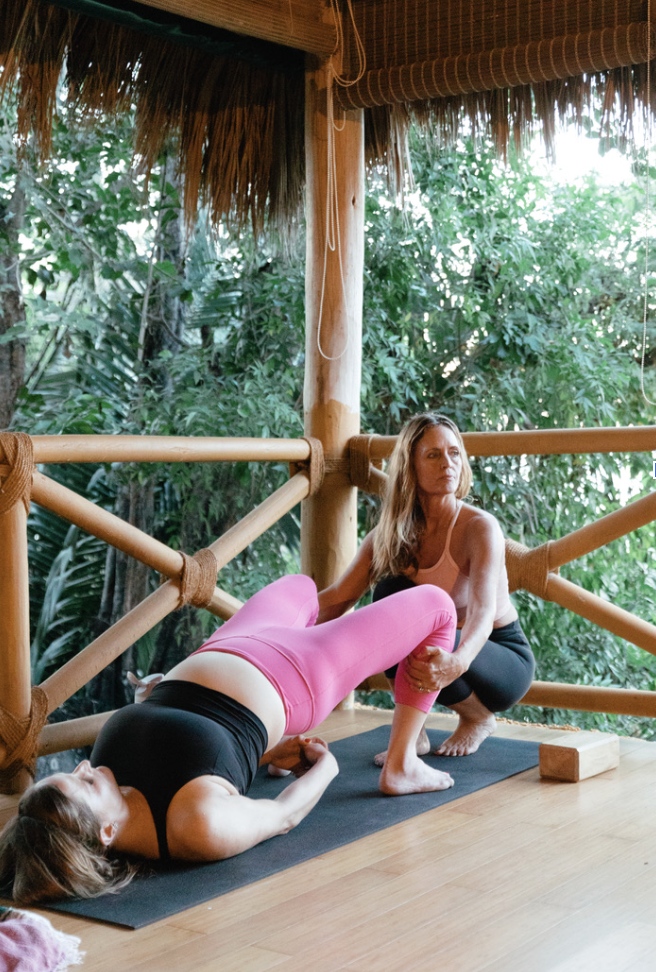
Jill: Yoga entered my life not as an escape, but as a reckoning. It invited me back into sensation, breath, rhythm, and choice.
Today, I don’t teach yoga as a corrective or an antidote to modern life. I teach it as a bridge — a way to stay embodied, relational, and awake inside full, complex lives. That understanding comes directly from having lived both worlds.
Angela: On your website, you describe yoga as more than asana, emphasizing play, connection, and heartful inquiry. How do you hold space for both strength and self-reflection in your classes and retreats?
Jill: For me, strength and self-reflection are not opposites. They’re collaborators.
Challenge has a way of revealing us. It shows where we brace, where we push, and where we move on habit alone.
Angela: And without reflection, that challenge can start to look like another kind of performance?
Jill: Exactly. Without reflection, challenge can become another performance. And without challenge, reflection can stay theoretical.
In my classes and retreats, I let the two walk hand in hand. Strong movement invites honesty. Pausing to notice what’s felt gives that honesty somewhere to land. I want students to feel capable in their bodies and gently curious about their inner world at the same time. That meeting point is where change begins — not through force, but through awareness and care.
Angela: Retreats are a core part of your work, from Mexico to Costa Rica and beyond. How do you design a retreat so that movement, inner exploration, and travel support one another rather than compete?
Jill: A well-designed retreat has a rhythm, not a packed schedule.
I think of retreats as containers rather than itineraries. Movement, rest, adventure, silence, shared meals, and laughter each have their moment.
Angela: So it’s less about maximizing experiences and more about letting people actually land?
Jill: Exactly. Travel opens the senses. Yoga helps us digest what we’re experiencing. Community gives it meaning.
I’m less interested in doing it all and more interested in letting people land. When guests feel cared for and not rushed, something subtle but powerful happens. They begin to trust their own timing again. That’s when the magic shows up — often quietly and unexpectedly.
Angela: Many practitioners feel caught between a “practice as performance” mindset and a more somatic, introspective approach. What helps students move from effort toward kindness with their felt experience?
Jill: I try to normalize it first, because so many students arrive believing there’s a right way to work hard in yoga.
Most of us were taught, explicitly or implicitly, that effort equals worth. That conditioning doesn’t disappear when we step onto the mat.
Angela: You’ve lived that kind of effort-based culture very intensely.
Jill: I have. In the financial services world, effort was everything. I slept with my devices. I worked long, relentless hours to be visible and taken seriously. That pace burned me out.
Running a yoga and wellness business for over 20 years has also required effort — long hours, consistency, care. But this effort feels aligned. Supporting others in being well makes sense to me at a soul level.
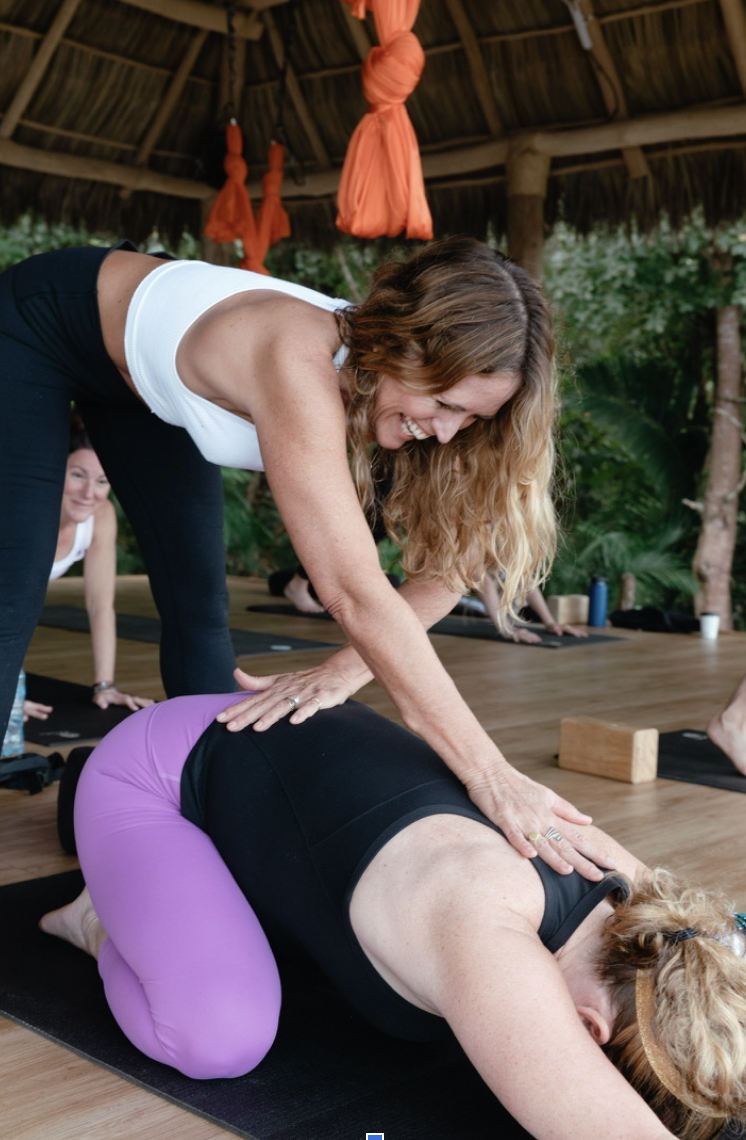
That contrast shapes how I teach. I often return to sthira sukham asanam — steadiness and ease — not by doing less, but by doing what’s appropriate.
Rather than trying to dismantle our relationship to effort all at once, I invite curiosity into it. We slow things down just enough to notice what effort actually feels like. We explore questions like: What happens if you stay for one more breath? What changes when you choose sensation over shape?
Kindness isn’t passive. It’s discerning. Over time, students learn they don’t have to abandon effort — they learn how to listen for the balance between stability and ease, and that skill often continues far beyond the mat.
“Rather than trying to dismantle our relationship to effort all at once, I invite curiosity into it. We slow things down just enough to notice what effort actually feels like. We explore questions like: What happens if you stay for one more breath?”
Practicing Yoga Inside Real Life
Angela: You also mentor teachers and students beyond classes, sometimes through holistic coaching. How do you balance holding space for others while maintaining your own practice and presence?
Jill: This has been an ongoing learning.
For a long time, I believed being supportive meant being highly available. A breast cancer diagnosis, followed closely by a global pandemic, gave me permission to rethink that.
Angela: What shifted for you?
Jill: I learned that presence isn’t something you give away. It’s something you tend to and return to. Saying no has made the yeses clearer and more spacious.
My own practice includes yoga, but also other movement modalities. As a nearly 57-year-old woman, lifting heavy things and cross-training feel essential, especially as my body has changed through peri- and post-menopause. Caring for myself in ways that are responsive and honest directly shapes how I show up as a teacher and mentor.
“I learned that presence isn’t something you give away... Supporting others doesn’t require self-erasure.”
Supporting others doesn’t require self-erasure. The more rooted I am in my own body and life, the more authentic and sustainable my presence becomes.
Jill’s work speaks to something we hear often at the Bend Yoga Festival: a desire for practices that meet people where they are — in real bodies, real lives, and real complexity.
You can explore Jill Knouse’s sessions and other presenters at the 2026 Bend Yoga Festival, and learn more about how this year’s programming brings together movement, nature, and science-informed practice in downtown Bend.